How to Plan In-Season Workouts: Three Principles for Better Competition-Phase Training
Updated July 15, 2026
By the traqqer Editorial Team
After months of base training, competition season arrives with a familiar question: should training continue in the same way, and what should be added or removed before a meet?
This article explains three principles for in-season planning and how traqqer’s AI-recommended workouts can support daily decisions.
Quick Answer: How Should In-Season Track Workouts Change?
In-season track workouts generally use less total volume while preserving event-specific quality, speed, and technical rhythm. The exact change depends on the event, training age, recent workload, and importance of the next competition. Treat any sample week as a framework to adjust, not a prescription.
A simple competition-week structure might include:
| Time before meet | Main purpose |
|---|---|
| 6–7 days | Final meaningful stimulus with controlled volume |
| 4–5 days | Technical or event-specific quality without exhaustion |
| 2–3 days | Short, fast work and rehearsal of key movements |
| 1 day | Rest or very light preparation based on the athlete’s routine |
If performance declines while RPE rises, reduce the load and review recovery rather than forcing the template.
Three Principles of In-Season Training
1. Reduce Volume and Raise Quality
Base training uses distance, repetitions, and time to build capacity. During the season, deliberately reduce total volume while maintaining the quality of speed, technical execution, and neuromuscular stimulus.
For a sprinter, that might mean:
- Replacing 5 × 500 m with approximately 3 × 300 m
- Centering sprint work on high-quality 60–80 m efforts
- Using heavy, low-repetition lifting to retain neural qualities
Athletes who equate more training with more strength can find this reduction uncomfortable. But carrying base-phase volume into competition can create fatigue before performance is expressed.
2. Distinguish Tapering from Peaking
| Phase | Purpose | Typical timing |
|---|---|---|
| Base | Build capacity with higher volume | More than four weeks before competition |
| Sharpening | Shift toward quality | Two to four weeks before competition |
| Tapering | Progressively reduce volume | About seven to ten days before competition |
| Peaking | Retain only a small neural stimulus | Final two to three days |
Tapering and peaking do not mean doing nothing. Short, fast, low-volume work can retain sharpness while fatigue falls.
3. Shape the Whole Season, Not a Separate Peak for Every Meet
Trying to peak fully for every competition is rarely sustainable. Identify A meets that receive a full peak and B meets that remain part of the training process.
Designing that wave requires you to combine training history, recent RPE and workload, and the competition schedule. That is where AI can reduce the work of organizing context.
traqqer’s AI-Recommended Workouts
traqqer can suggest a workout based on the athlete’s individual context. The request asks for only three inputs:
- Intensity from 1 to 10
- Training type: conditioning, weights, running, technique, or automatic
- Event: your primary event or a recommendation
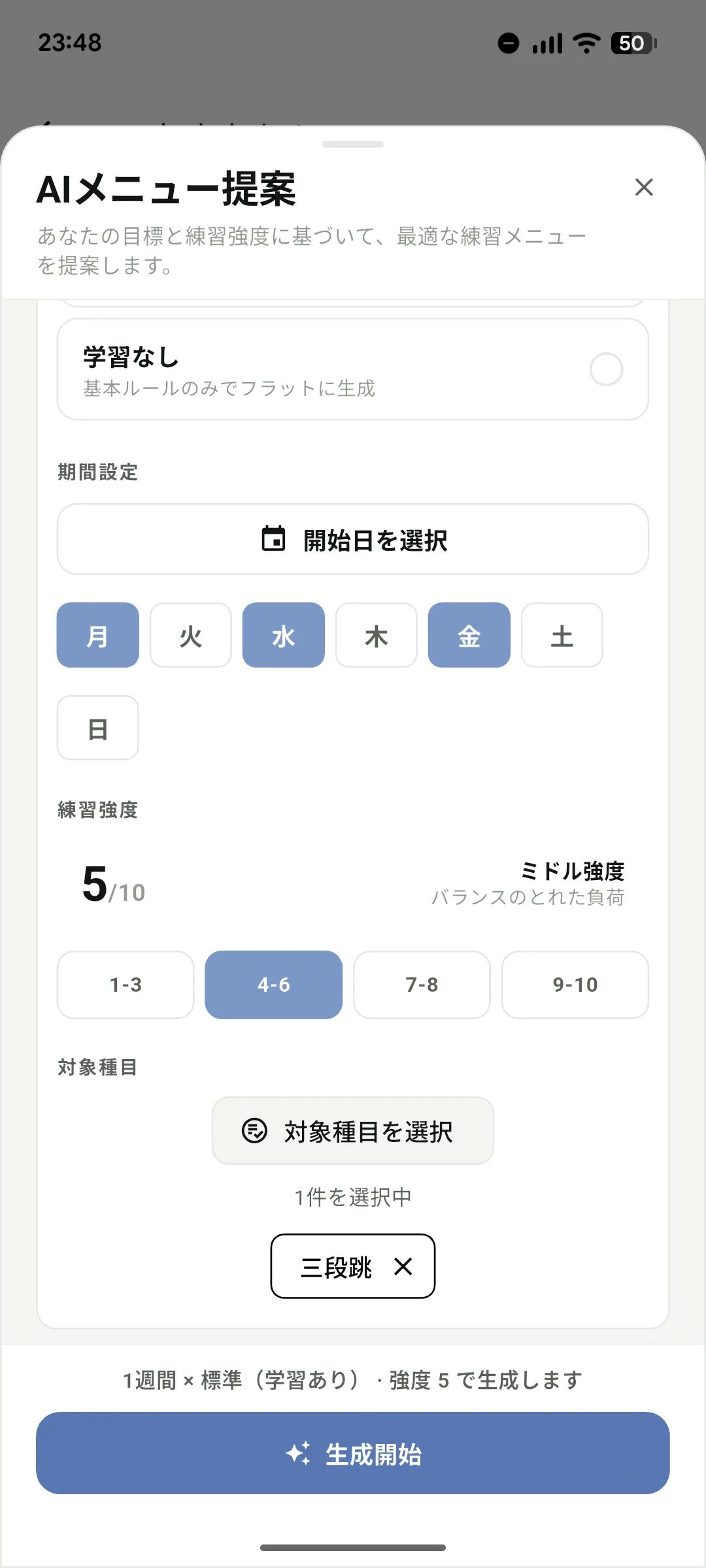
The result includes a title, explanation, and specific items such as sets, distance, and recovery.
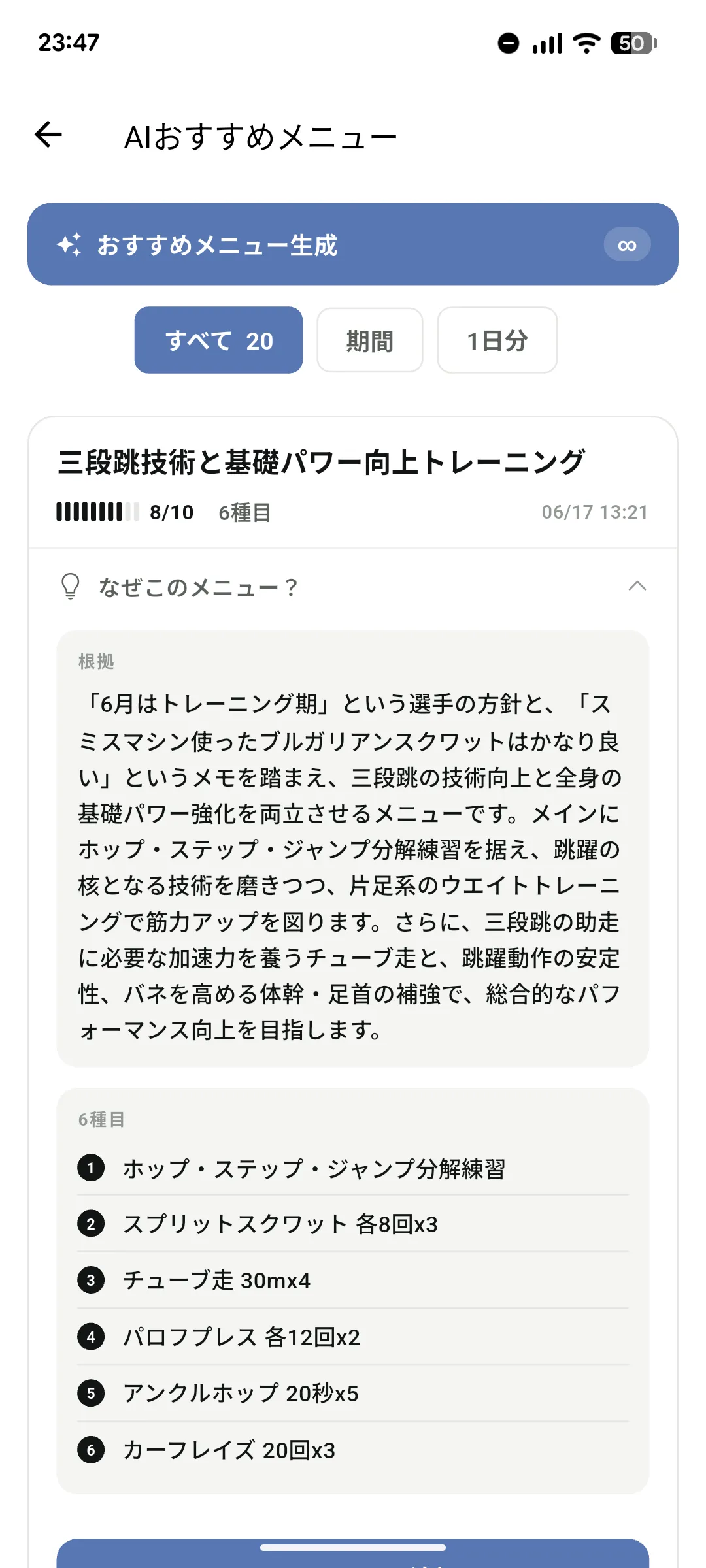
Context Used by the Suggestion
Although the form is short, the system can use:
- Profile data such as height, weight, personal bests, and primary events
- Recent training history
- Competition dates and events
- Recent RPE and workload trends
- Previously accepted or rejected AI suggestions
- Injury history and hard constraints, such as avoiding jumps
- Subjective notes such as “right hamstring feels tight”
The intended result is a workout matched to the current phase. Eighteen days before a meet may call for retaining volume and a neural stimulus; ten days may begin a taper; three days may call for short, fast, low-volume work. An elevated workload trend can also justify reducing the requested intensity.
Three Steps
- Generate: enter the three inputs
- Review: inspect the resulting cards and expand the details
- Adopt: add a selected workout to your menu and record it as today’s training
Whether a suggestion is adopted is saved as feedback for future recommendations.
Use AI as a Draft, Not an Authority
AI cannot fully understand every injury history or the importance of every meet. Practical uses include:
- Generating a starting point on a day when you are unsure what to do
- Discovering a new exercise late in the season
- Getting a second opinion when accumulated fatigue is difficult to notice
The athlete or coach still makes the final decision.
Summary
In season, reduce volume, distinguish tapering from peaking, and shape priorities across the whole competition calendar. traqqer aims to organize the athlete’s current context so that daily decisions require less mental overhead while leaving the final judgment with the athlete.
Frequently Asked Questions
Should sprinters lift weights during competition season?
Many sprinters retain strength work at a lower volume, but the right dose depends on training history, soreness, event schedule, and how lifting affects sprint quality. Avoid introducing an unfamiliar, high-fatigue program immediately before an important meet.
How many hard sessions should I do before a meet?
There is no universal number. Start with the athlete’s normal rhythm, then adjust for the event, recovery response, travel, and competition priority. The final days should reduce fatigue without removing every high-quality stimulus.
Related Articles
- How AI-recommended workouts work
- Tapering before competition
- How to use RPE and ACWR
- Recording pain and returning from injury
References
Start Your Journey with traqqer
traqqer is an AI-powered app that helps you build better habits.
Download now and transform your daily routines for a better life.
